
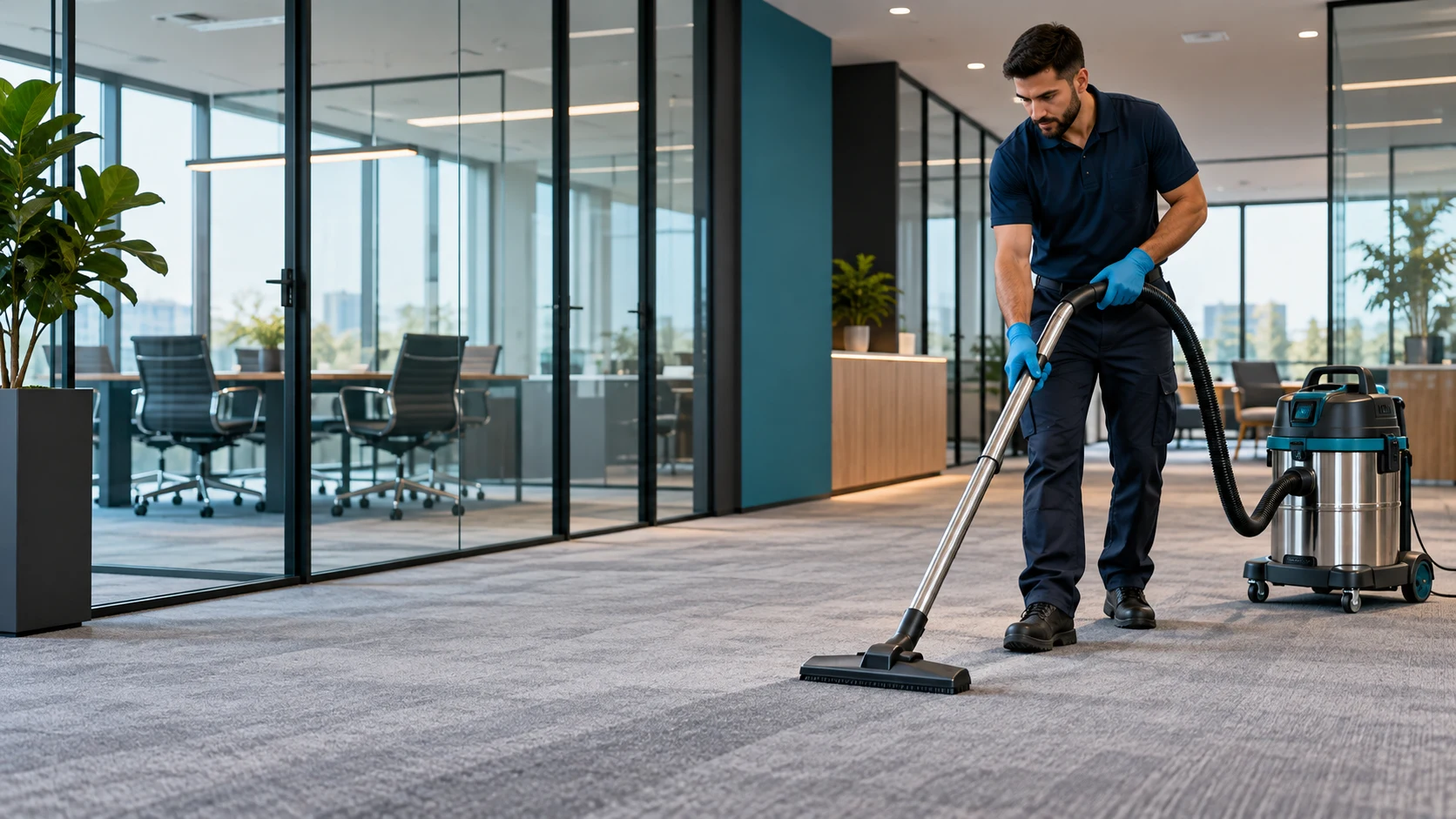
A newly fitted office can look complete while still carrying dust on ledges, marks on glass and debris in corners. Those details become very noticeable when a client walks through the doors. Post-construction cleaning should therefore be planned as part of handover, with a defined scope and enough time to inspect the result.
For Edmonton contractors, property managers and business owners, the important question is not simply whether the building needs a clean. It is whether the site is ready to be cleaned, which finishes need protection and what must be completed before the space can be presented to the next occupant.
Confirm that the site is ready
Before booking the final clean, identify remaining trades, incomplete rooms and areas where dust-producing work will continue. Cleaning a room before sanding or drilling has finished usually means the same surfaces will need attention again.
Agree access, working utilities, waste arrangements and who controls the site. Tell the provider about restricted areas and relevant hazards. A cleaning crew should not have to infer whether an unfinished room is safe to enter.
Ordinary post-construction cleaning is not hazardous-material remediation. Suspected asbestos, silica-containing dust or unknown contamination requires assessment and an appropriate controlled method. CCOHS cautions against dry sweeping and compressed-air cleanup of silica. Do not assume a domestic vacuum or an ordinary broom is suitable for construction residue.
Divide the work into sensible stages
Initial cleanup
The initial stage addresses agreed loose debris and prepares accessible areas for more detailed work. Clarify who removes heavy materials, sharp waste, surplus fittings and packaging. Bulk construction waste removal should never be assumed to be part of a general cleaning quotation.
Detailed cleaning
Once the site is suitably ready, detail work can focus on accessible surfaces, ledges, door frames, cabinetry, fixtures, glass and floors. Work should be organised to avoid repeatedly contaminating areas that have already been cleaned.
Final presentation and inspection
The last stage checks the agreed rooms before handover. If trades return after the clean, a touch-up visit may be needed. Define that possibility in the schedule and quotation rather than assuming unlimited return visits.
These stages are a planning framework. A small renovation may need a simpler arrangement, while a phased building project may require separate area releases.
What belongs in a handover cleaning scope?
| Area | Items to discuss | Important boundary |
|---|---|---|
| Glass and frames | Dust, accessible tracks, marks and agreed labels | Scratches and glazing defects need separate reporting |
| Doors and trim | Handles, frames, ledges and visible residue | Paint damage is not a cleaning defect |
| Cabinetry | Accessible shelves and internal surfaces | Confirm whether cabinets are empty |
| Kitchens and washrooms | Fixtures, counters, mirrors and floors | Utilities and fittings must be ready for use |
| Floors | Loose debris, residue and suitable finish care | Restoration and repair require separate agreement |
| Vents and grilles | Accessible external surfaces | Internal duct cleaning is a distinct service |
Put each item into the quotation in plain language. “All windows” can mean different things to different people; specify interior or exterior, accessible height and whether tracks and frames are included.
Protect new finishes during cleaning
Identify the installed materials before choosing products or tools. Flooring, coated glass, stone, metal and painted surfaces can have different care requirements. Ask the contractor for relevant finish instructions and warranties where available.
Do not assume adhesive, grout haze or paint splashes can be removed safely with a generic solvent or scraper. Some residues need specialist treatment; some apparent marks are damage. Agree a suitable method and a discreet test where appropriate before treating a larger area.
Record pre-existing scratches, chips and unfinished details. That gives the contractor and cleaner a common reference and avoids confusing workmanship issues with cleaning quality.
Manage dust without simply moving it around
Dust removal requires the right equipment and procedure for the identified material. The aim is to collect residue without spreading it to other rooms or exposing people. Construction dust can be hazardous, including particles that are not readily visible; the CCOHS construction-dust source below explains why assessment matters.
Discuss whether the required equipment, access and controls are within the cleaning provider's capability. Do not describe a job as routine solely because the dust layer looks small. Keep active trade work and final-clean areas coordinated through the site manager.
Plan the handover inspection
Walk through the agreed areas with the written scope. Check ledges, corners, fixtures, glass and floors under normal room lighting. Note particular items rather than relying on a general impression.
Separate cleaning touch-ups from construction defects and incomplete works. A scratch, leaking fixture or badly fitted door should go to the responsible trade. A missed accessible shelf can go on the cleaning list. Assign responsibility and a completion time for each issue.
Leave enough time between cleaning and occupation for inspection and any agreed corrections. Avoid treating the clean as a spare hour at the end of an already crowded handover day.
Discuss your Edmonton project with GG Sparkle
GG Sparkle offers post-construction cleaning. Send the project type, approximate area, finish date, planned handover date, photographs and the areas requiring attention. Explain whether the premises are an office, commercial unit, building or residential property. A walkthrough can help confirm scope, access and whether any specialist work is outside the proposed service.
Frequently asked questions
When should the final clean be booked?
Plan it early, then confirm site readiness as the work progresses. Ideally, the relevant dust-producing trades should have finished in the areas released for final cleaning. Build in time for a walkthrough before occupation.
Is construction waste removal included?
Only if the written quotation says so. Identify heavy debris, sharp waste and disposal requirements separately from surface cleaning.
Can cleaners remove every paint or adhesive mark?
No responsible provider should promise that without assessing the material and residue. Some marks need specialist treatment, and others may be permanent damage. Agree the method before work begins.
Does post-construction cleaning include the ventilation ducts?
Accessible external grilles may be included when specified. Internal duct cleaning is a separate scope and should be discussed explicitly.
Sources
Construction dust guidance: https://www.ccohs.ca/newsletters/hsreport/issues/2016/03/ezine.html
Silica cleanup precautions: https://www.ccohs.ca/oshanswers/chemicals/chem_profiles/quartz_silica.html