
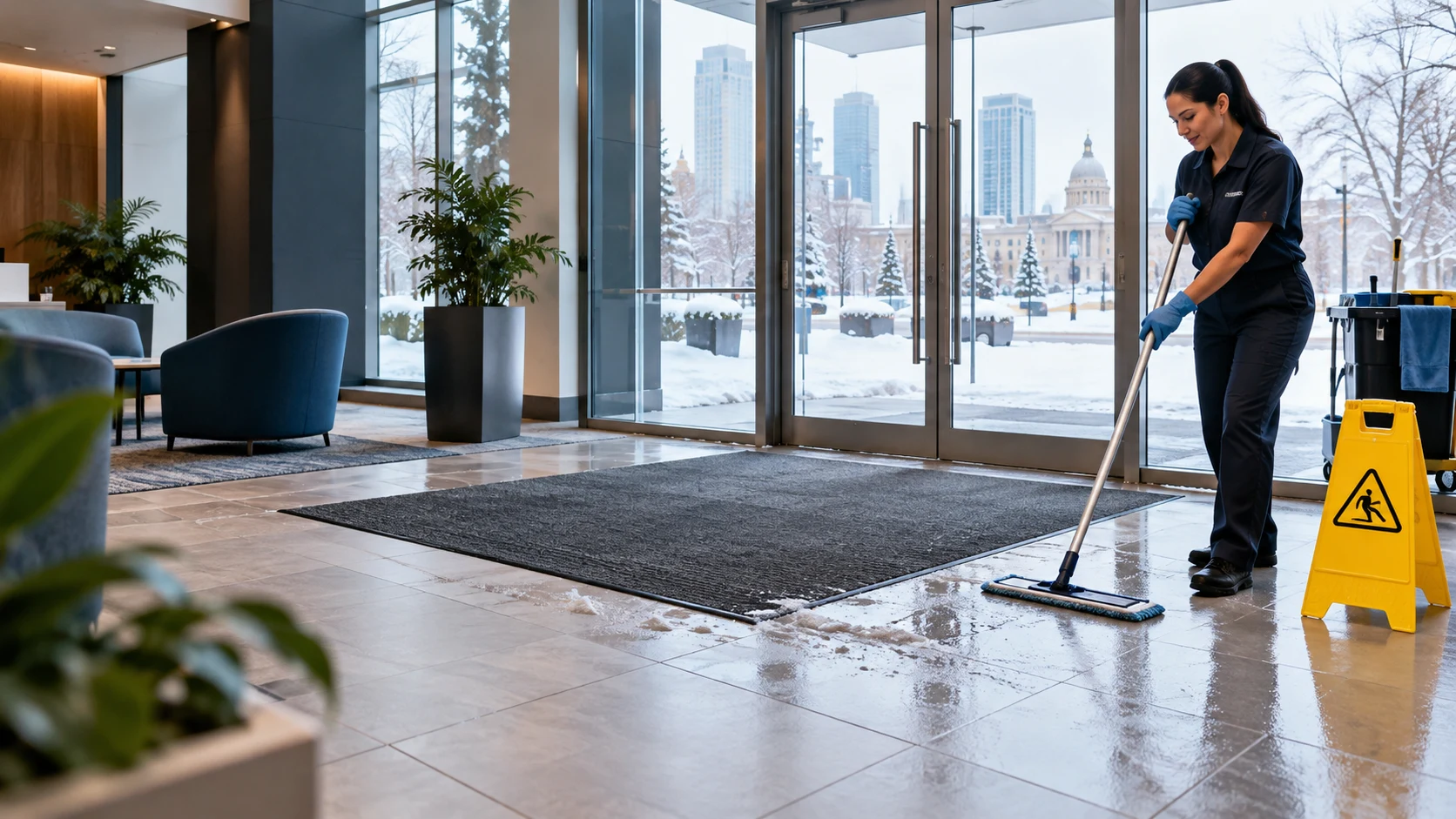
Winter entrance care needs more than an extra mop at the end of the day. Wet footwear, gritty residue and busy arrival periods can change conditions between scheduled cleaning visits. For an Edmonton office, the practical goal is to keep soil near the entrance, deal with moisture promptly and maintain a clear route for staff and visitors.
This guide focuses on indoor entrance cleaning and coordination with building management. It does not offer a snow-removal service or replace a site-specific safety assessment. Your outdoor contractor, reception team and cleaning provider each need to know where their responsibilities begin and end.
Review the entrance before the busy winter period
Walk the route from the outside door to reception. Look at where people pause, turn, queue or step off the mat. Check which nearby floor areas become wet and whether mats interfere with door movement or walking aids.
Discuss the floor finish with your provider. Salt residue, moisture and cleaning products need a method compatible with the installed material. A product that works on one floor may be unsuitable for another, especially where coatings or manufacturer's care instructions apply.
Photographs of recurring trouble spots can help explain the issue. Use them to agree a practical plan rather than relying on a general instruction to “keep the lobby clean”.
Use entrance mats as part of the system
Well-positioned mats can help limit dirt carried into a building. They still need inspection and maintenance. A saturated or displaced mat can leave moisture on the surrounding floor and create another problem.
Check that mats lie flat, stay in position and do not block doors. Inspect for curled edges and accumulated grit. Agree who will clean, exchange or replace them and what staff should do when a mat is wet before the next cleaning visit.
There is no universal mat length or exchange frequency suitable for every office. Consider entrance layout, visitor traffic and observed conditions rather than choosing an arrangement only because it fits the reception design.
Separate loose soil, moisture and residue
A useful entrance routine addresses the type of soil present. Collect loose grit with equipment suitable for the floor and conditions. Deal with tracked-in moisture using a suitable controlled method. Treat remaining residue according to the floor and cleaning-product instructions.
Repeatedly spreading dirty solution across the lobby can leave a floor looking worse. Clean materials, appropriate product dilution and an agreed rinse or recovery method matter where the chosen product and surface require them.
Avoid improvised chemical mixtures. CCOHS advises against mixing cleaning products and emphasises reading product information. More concentrated solution is not automatically a better answer to a stubborn winter mark.
Inspect between scheduled visits
An evening clean cannot address every wet arrival at lunchtime. Assign someone on site to notice changing conditions and initiate the agreed response. That person does not need to undertake specialist cleaning; they need to know whom to contact and how the area will be controlled.
| When to check | What to look for | Action to agree |
|---|---|---|
| Before the office opens | Mat position and leftover moisture | Correct the condition before arrivals |
| After a busy arrival period | Grit, wet tracks and pooling | Arrange a suitable cleanup |
| During changing weather | Conditions extending beyond the mats | Reassess the response and traffic route |
| At the end of the day | Residue and mat condition | Include findings in the next cleaning visit |
These are suggested checkpoints. Add inspections when actual conditions require them. Keep the process simple enough that staff can use it during a busy day.
Control the work area while cleaning
Cleaning itself can temporarily change a walking surface. Coordinate the timing and keep people away from affected areas where necessary. Consider a suitable alternative route and remove equipment from circulation areas when the task is finished.
CCOHS guidance identifies spills, wet surfaces and obstructions as relevant slip and trip concerns. Warning signs are an alert, not a substitute for removing the hazard or controlling access. Inspect the surface before returning the area to normal use.
If the same location remains slippery despite cleaning, report it to building management. The cause may involve the surface, drainage, mat arrangement or the cleaning method. Repeating the same treatment without reviewing the cause may leave the problem unresolved.
Coordinate indoor and outdoor responsibilities
The indoor provider should know where exterior maintenance ends. Someone must oversee the transition at the doorway and communicate when outdoor conditions are affecting the lobby.
The City of Edmonton publishes winter information for businesses and commercial property owners. Review its current guidance with the person responsible for your property. Do not assume an indoor office cleaning agreement also covers sidewalks, parking areas or ice control.
Keep emergency contacts and escalation instructions available to reception staff. If access becomes unsafe, the building's responsible manager should decide the appropriate response.
Set a winter scope with GG Sparkle
When requesting Edmonton office or building cleaning, mention your entrance layout, usual visitor traffic, mat arrangements and the problems experienced during winter. Ask how routine floor care and any additional visits would be agreed and priced. Describe outdoor responsibilities separately so the indoor scope is clear.
GG Sparkle can discuss your cleaning requirements through the contact form or at +1 825-771-0290. A clear brief makes it easier to propose work relevant to your premises.
Frequently asked questions
Is once-a-day entrance cleaning enough?
It depends on traffic and conditions. A busy wet entrance may need attention between visits. Agree an on-site inspection and response arrangement rather than expecting one visit to cover changing conditions all day.
Can salt residue be removed with any floor cleaner?
Use a method compatible with the floor and product instructions. Tell the provider what material is installed and share its care guidance where available.
Do mats eliminate slip risks?
No. Mats need checking, and moisture can still reach surrounding floors. Their position and condition should be part of the inspection routine.
Is outdoor snow removal included in office cleaning?
Do not assume it is. Indoor cleaning, sidewalks, parking areas and ice control have distinct responsibilities that should be confirmed in writing.
Sources
Slip and trip prevention: https://www.ccohs.ca/oshanswers/safety_haz/falls.html
Cleaning-product handling and entrance mats: https://www.ccohs.ca/oshanswers/chemicals/cleaning-products-working-safely.html
City of Edmonton winter information for businesses: https://www.edmonton.ca/sites/default/files/public-files/assets/PDF/SNIC-Info-Sheet-Businesses.pdf